If you have seen a building that has been recently erected after just two monsoons, you would be able to observe how the initial appearance becomes stained, lacks luster, and in certain cases, even grows algae.
This process is much faster in humid conditions like those in Mumbai, where there is high pollution and rainfall.
However, the problem does not lie solely in protecting the exterior walls, but also in doing so without sacrificing the facade’s aesthetic appearance. For instance, nobody wants an unnatural-looking gloss on their building where a natural look was desired.
In this blog post, we will explore how building facades can be protected in an effective manner.
Why Facade Protection Should Not Be Ignored
As evident from various sites, facade deterioration typically begins from minor occurrences that often go unnoticed.
- Some of the problems faced include:
- Discolorations developing into wall stains
- Moisture intrusion resulting in damp areas
- Dust particles are accumulating on the surface
- Growth of algae on exterior walls
These will not only impact your aesthetic but also building maintenance costs. If you already have some stains in place, you can refer to our guide on stain removal.
Where Most People Go Wrong
A common mistake we make is opting for facade protection solutions that alter the surface’s appearance.
Examples include:
- Surface treatments that give a glossy or plasticky appearance
- Protective coatings that peel off after some months
- Film-forming layers that keep moisture locked under the surface
What is the end result?
The facade looks fake and, at times, even uglier than before!
How to Protect Facades Without Affecting Design
1. Use Protection That Doesn’t Change the Surface Look
If your building’s facade features natural stone, concrete, or textured paint, the material becomes an integral element of the design.
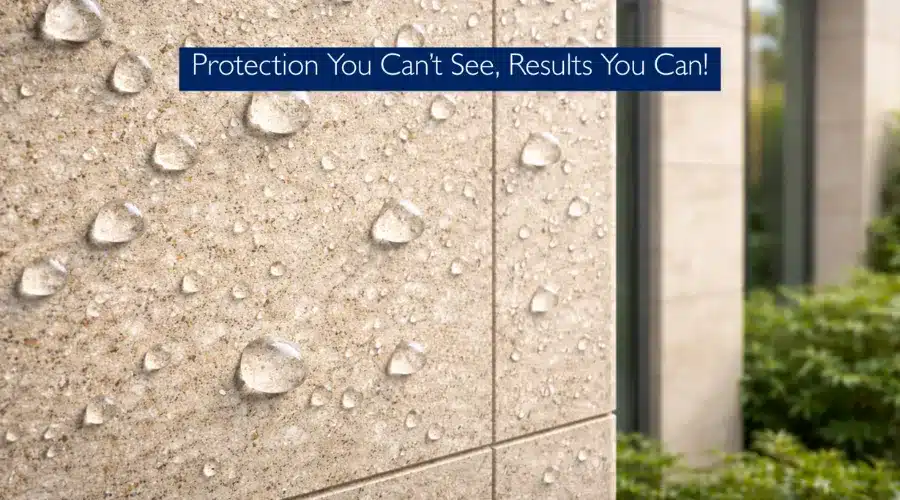
Therefore, applying ProtectGuard Range products like ProtectGuard Color and ProtectGuard is quite appropriate since this solution protects from moisture and discoloration while preserving the natural appearance. There is no need to apply a visible coat, only to protect.
2. Add an Extra Layer in High-Exposure Areas
There are sections of the building that experience greater strain than others; for instance, those exposed to weather elements such as rainfall and pollution.
As an alternative to allowing degradation to occur before taking action, using a topcoat such as ProtectGuard Top Coat could prove advantageous for long-term facade protection.
3. Choose Multi-Surface Protection for Simplicity
In contemporary architecture, the use of a single material for a façade is uncommon. The most common combination includes materials such as concrete, tiles, and stones.
Handling several products on different surfaces becomes difficult. Products such as ProtectGuard make life easy by protecting surfaces from water, oil, and stains.
4. Don’t Ignore Marble and Granite Surfaces
High-end facades are usually made of marble and granite. However, these materials will require additional maintenance.
If you do not take adequate measures, they might tarnish or get dirty, which is difficult to clean.
Protecting them with ProtectGuardMG is a small effort that ensures their beauty lasts for years.
Simple Practices That Make a Big Difference
Complex solutions do not always have to be sought. Oftentimes, it is simplicity that is the key.
✔ Cleaning proves effective
Dust and pollutants accumulate very rapidly, particularly in cities. Proper cleaning helps avoid the accumulation of grime.
✔ Opt for breathable protection at all times
This is an aspect often ignored by many. A surface’s inability to breathe leads to moisture accumulation, which eventually results in peeling or damage.
✔ No need to wait for damage to occur
By the time a stain appears on the surface, damage will have already occurred. Prevention is always better than a cure. This is why breathable facade protection is important.
Balancing Protection and Aesthetics
Ultimately, the preservation of a facade goes beyond merely prolonging its lifespan; it involves preserving its intended purpose.
The proper technique would involve:
- Retaining its original appearance
- Sheltering it from environmental and atmospheric damage
- Minimizing maintenance requirements
- Being applicable to a variety of materials
If executed successfully, the structure will retain its original appeal without needing constant restoration work.
Conclusion
However, preserving a façade does not necessitate sacrificing aesthetics. The most effective facade protection method is virtually invisible to the naked eye.
If you select the correct solutions and apply easy-to-follow maintenance procedures, you will preserve your building’s cleanliness, durability, and beauty for years to come.
At Guard Industry, we provide advanced protection solutions, including ProtectGuard Color, ProtectGuard Top Coat, ProtectGuard, and ProtectGuard MG, designed to safeguard surfaces while preserving their natural beauty.
Investing in the right façade protection today ensures your building remains strong, elegant, and well-preserved well into the future. With Guard Industry, you can do it with confidence.