If you have had experiences such as paint peeling, wet spots appearing, and stain reappearance even after proper cleaning, you are not the only one.
Many people try to preserve their walls, floors, or stone facade, but end up using the wrong sealers. Most sealants are designed only to prevent water penetration, but they pay no attention to what happens underneath.
It is at this point that mistakes are made.
A good, breathable sealer for interior and exterior use should have strong water- and stain-repellency.
What Is a Breathable Sealer And Why Should You Care?
The breathable sealer is not a thick layer that lies over your surface. It goes within the substance and cuts down the water absorption capacity while allowing the moisture vapor to pass through.
Why do you need a breathable sealant?
Your walls are not entirely dry internally. There is always going to be moisture present. But if that moisture is locked in, it causes trouble. This means that instead of simply being “waterproof,” an exterior sealer needs to be able to deal with moisture.
What Happens When Surfaces Can’t Breathe?
It is the biggest mistake people usually make when applying a coating on the walls, believing that it will safeguard them, and then, after some time, you notice:
- The paint is peeling off
- The appearance of blisters
- Reappearance of dampness
- Appearance of cracks
Why? Because the moisture gets trapped in there.
When that trapped moisture tries to find a way out, it puts pressure on the surface and gradually destroys the whole material internally. That is why the choice of a breathable sealant or an effective wall protection becomes vital.
How a Breathable Sealer Solves These Problems
Now let’s look at what actually works.
A breathable sealer creates a balance:
- It reduces water entering from outside
- It allows moisture inside to escape
This simple difference leads to big benefits:
✔ No Moisture Build-Up
✔ Better Protection from Rain & Stains
✔ Longer Life of Paint & Surfaces
✔ Natural Look Stays Intact
Since it doesn’t form a thick layer, your surface doesn’t look artificial or glossy.
Where Should You Actually Use a Breathable Sealer?
1. Interior Walls
For interior walls that absorb moisture easily—particularly in the kitchen or bathroom—a breathable sealer will manage moisture without compromising the paint’s integrity.
2. Exterior Walls
Exterior walls must endure exposure to rain, sunlight, and atmospheric pollutants each day.
A quality exterior sealant will guarantee:
- No penetration of water
- No entrapment of moisture
- Cleaner walls for an extended period
This makes it an ideal choice as an exterior wall protector.
3. Stone Surfaces
Stone surfaces are visually stunning but also delicate. You may observe:
- Oil and water stains
- Fading over time
- The settling of dirt on the surface
How to Choose the Right Sealer?
You don’t need to overthink this. Just check:
- Does it penetrate the surface?
- Does it allow breathability?
- Does it change the appearance?
- Can it be used on multiple surfaces?
If the answer is yes, you’re on the right track.
Simple Tips to Get Better Results
Even the best product won’t work if applied incorrectly.
- ✔ Clean the surface before application
- ✔ Make sure it’s dry
- ✔ Apply evenly
- ✔ Don’t rush the drying process
These small steps make a big difference in how well your breathable sealer performs.
Conclusion
A breathable sealer enables the material to function properly. It can be applied indoors on floors and outdoors on wall cladding. It allows moisture to pass through the surface while preventing water penetration, making it both efficient and aesthetically pleasing.
Should you be seeking a professional solution:
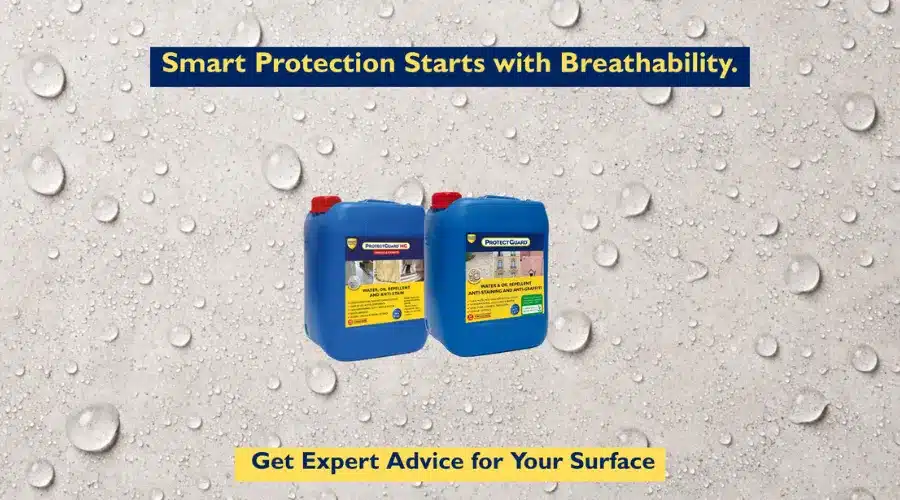
ProtectGuard – A versatile breathable sealer and excellent exterior wall protector for porous surfaces such as sandstone and bricks.
ProtectGuard MG – A breathable sealer specially developed for floors and walls made of marble, granite, and other low-porous materials.
These products provide:
- Protection from moisture and stains
- Breathability
- A natural look
- Durability
Contact us now to select a suitable breathable sealer for interior and exterior applications.